
Walking Backward on Treadmills Isn’t A Trend, It’s Science

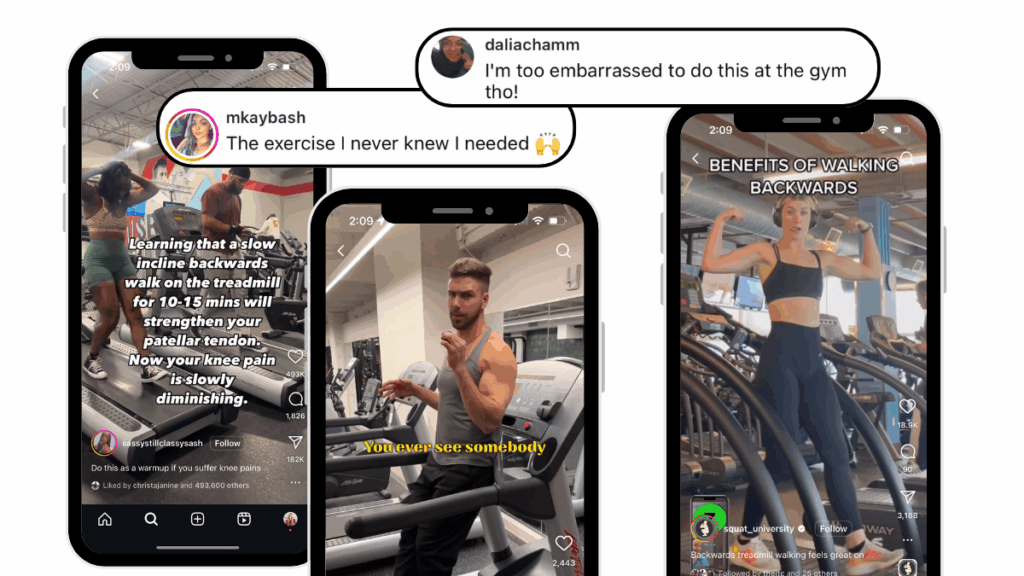
If you’ve seen gym‑goers facing the back of the treadmill and scratched your head — you’re not alone. Walking backward, sometimes called retro walking, is popping up on social media and in fitness spaces not just as a quirky flex but because it’s grounded in movement science and rehabilitation research.
Rather than being a silly trend, backward walking actually engages your body in ways forward walking doesn’t — and studies in clinical and fitness settings back that up. Let’s break down why people are doing it and what the research says.
How To Do It
Backward walking simply means moving in reverse — often on a treadmill at a slow, controlled pace — rather than the familiar forward step. It’s an unfamiliar movement, which forces your muscles and nervous system to work differently to maintain balance and coordination, engaging muscles like the quadriceps, glutes, and hamstrings in ways forward walking doesn’t.
Researchers have explored this movement across clinical populations and healthy adults, showing that reverse walking engages movement patterns that aren’t typically used in forward gait.
5 Science‑Backed Benefits of Backward Walking
Improves Balance, Stability & Gait: Backward treadmill walking has been shown to improve balance, walking speed, and cardiopulmonary fitness when added to conventional therapy in people with chronic stroke.
In one trial, participants who walked backward on a treadmill three times a week for four weeks saw significant improvements in balance scores, walking speed, and cardiorespiratory measures compared with traditional therapy alone.
Reduces Pain & Improves Function in Knee Osteoarthritis: A systematic review and meta‑analysis of randomized controlled trials found that combining backward walking exercise with conventional rehabilitation significantly reduced pain and disability in individuals with knee osteoarthritis compared with rehab alone. (Systematic Review & Meta‑Analysis, 2025)
Strengthens Underused Muscles: Biomechanically, backward walking shifts muscle recruitment, often increasing demand on the quadriceps, glutes, and hamstrings while reducing compressive knee joint forces compared with forward gait. One gait analysis study found that retro walking significantly reduced the external knee adduction moment — a biomechanical marker associated with osteoarthritis progression — compared with forward walking.

Find Your Perfect Workout

Boosts Coordination & Proprioception: Because backward walking requires unfamiliar movement patterns, it challenges motor planning and balance, which can enhance proprioception — your body’s sense of where it is in space — and overall coordination. These neurological demands contribute to improved movement quality in both rehab and fitness contexts.
May Increase Energy Expenditure: Backward walking burns more energy than forward walking at the same speed because it recruits muscles differently and is less mechanically efficient. Studies show it can raise heart rate and oxygen consumption, sometimes burning roughly 5–7 kcal per minute. The tradeoff: because it’s more demanding, you might not be able to maintain it as long as forward walking, so overall calorie burn depends on intensity, duration and ultimately your enjoyability.
How to Try It (and Be Safe)
Backward walking can be a safe and effective way to challenge your muscles and nervous system — as long as you approach it carefully.
Start slow: aim for 0.5–2 mph (0.8–3 km/h) on a treadmill with handrails, and keep the incline flat or very slight (0–2%) until you feel stable.
Gradually increase duration to 3–5 minutes per set, building up over time as comfort and coordination improve.
Avoid sudden stops or turns, and if you have balance issues or vestibular conditions, work with a trainer or physical therapist first. Clinical studies typically use controlled, slow backward walking, emphasizing proper form over speed.
Why try it? Backward walking can:
✔ Improve balance, coordination, and proprioception
✔ Strengthen under-used muscles like quadriceps, glutes, and hamstrings
✔ Enhance gait quality and support rehab movement patterns
✔ Increase energy expenditure — though the tradeoff is you may not sustain it as long as forward walking
Think of backward walking as a short, controlled complement to your usual treadmill or rehab routine. Even a few minutes per session can provide measurable benefits — and with gradual progression, it’s safe, effective, and surprisingly challenging.
Backwards Walking Bottom Line
Walking backward on a treadmill looks unusual — but there are real scientific reasons people are doing it. Whether it’s used in rehab for stroke survivors, in osteoarthritis management to reduce pain and improve function, or simply to challenge your balance and muscles in a new way, the evidence shows it’s not just a weird trend.
If you’re curious, start slow, keep it controlled, and think of it as a novel way to challenge your nervous system and muscles — not a magic fix, but a movement you can add to your toolbox.
Morning Report Podcast
A short-and-sweet minute morning episode Monday-Friday covering all 3 daily news stories. Exclusively in the Looli App.